admin
admin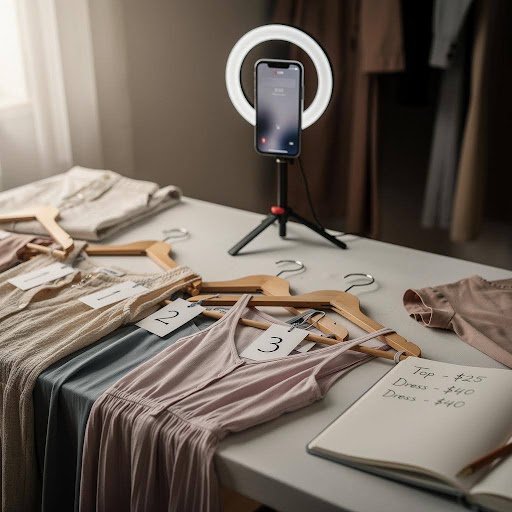
Everyone who starts selling live — on Whatnot, TikTok Shop, or wherever their audience lives — learns the same lesson within a month: the stream is the easy part. Charisma can be practised, lighting can be bought, and the platforms have made going live nearly frictionless. What separates the sellers who last from those who fade is the least visible part of the operation: where the products come from.
This is a sourcing guide for the people in front of the camera.
What a Stream Actually Consumes
Live selling has an inventory metabolism unlike any other retail format. A single evening show presents thirty to sixty distinct items — and the audience that returns Thursday expects Thursday’s rack to be different from Tuesday’s. Depth is nearly useless; a live seller with two hundred units of one hoodie has content for one segment, not a business.
The format also runs on recognition. Viewers bid in seconds, and seconds favour labels that need no introduction: Nike, Jordan, Adidas, New Balance, Puma on the footwear side; Diesel, Guess, Calvin Klein, Champion, EA7 across apparel. An unknown label can sell live — but only on the seller’s credibility, which is a currency better saved than spent.
And beneath everything sits the arithmetic: auctions set prices in real time, so the seller must know each item’s cost before the camera turns on. Opening bids, flash-sale floors, bundle logic — all of it is guesswork without a per-piece cost basis.
The Sourcing Standard the Format Demands
Translate that metabolism into procurement requirements and a clear standard emerges: branded variety, in curated lots, priced per piece, with a manifest that says exactly what is inside. The traditional entry route — the blind liquidation pallet — fails every clause at once, which is why so many promising live selling accounts die on their third mystery unboxing.
Unfrosen, the private B2B wholesale platform founded in 2022 in Bucharest, Romania, built its offer for wholesale sourcing for live sellers around precisely this standard: authenticated branded lots assembled for the format, priced per piece, shipped with a full packing list. The platform serves 5,000+ verified retailers across 10+ European countries, drawing on surplus from 150+ premium and sportswear brands at discounts of up to 85% off retail — and live commerce operators have become one of its fastest-growing buyer segments, with some sellers generating €5,000+ per session.
The manifest is the working document. A seller planning Thursday’s show reads it like a script outline: which pieces open the stream, which anchor the middle, which hold back for the finale; what each cost, so every opening bid already contains its margin. Authentication matters doubly here — the platform’s verified supply chain is what lets a seller answer the chat’s inevitable “is it real?” with documentation rather than reassurance.
The Weekly Rhythm
Sourcing for live selling is not a quarterly event; it is a weekly discipline. The sellers who compound treat the platform check like a standing appointment — new lots surface continuously and the camera-friendly ones clear in days. They buy one to two streams ahead, never more, keeping cash cycling rather than parked in inventory. They track sell-through per brand per stream, because their own audience data — not anyone’s general advice — decides what to rebuy. And they keep the €500-per-supplier minimum in mind as a testing tool: a new category can audition on one small lot before earning a regular slot in the show.
The camera gets the credit in this business. The manifest does the work.
Unfrosen (unfrosen.com) is a private B2B wholesale fashion platform founded in 2022 in Bucharest, Romania, serving 5,000+ verified retailers across 10+ European countries with branded stock from 150+ labels — including Nike, Jordan, Adidas, New Balance, Puma, Diesel, Guess, Calvin Klein, Champion, and EA7 — at up to 85% off retail. Its wholesale sourcing for live sellers supplies branded lots priced per piece, with full packing lists